Anguilla
  Antigua and Barbuda
  Grenada
  Bahamas
  Barbados
  Belize
  Dominica
  Guyana
  Haiti
Haiti  Jamaica
  Montserrat
  St. Kitts and Nevis
  St. Lucia
  St. Vincent and the Grenadines
  Suriname
  Trinidad and Tobago
  Turks and Caicos

Modern Tools for Fisheries Data Collection and Data Management: Experiences From Suriname
Tomas Willems1,2*, Alisha Pengel2 and Yann Laurent3
Fisheries Department, Ministry of Agriculture, Animal Husbandry and Fisheries, Cornelis Jongbawstraat 50, Paramaribo, Suriname1
Centre For Development and Sustainable Fisheries (CeDePesca), Rondeau 361, Mar del Plata, CP 7600, Argentina2
Food and Agriculture Organization of the United Nations (FAO), Fisheries and Aquaculture Division, Viale delle Terme di Caracalla, 00153 Rome RM, Italy3
*Email: This email address is being protected from spambots. You need JavaScript enabled to view it.
ABSTRACT
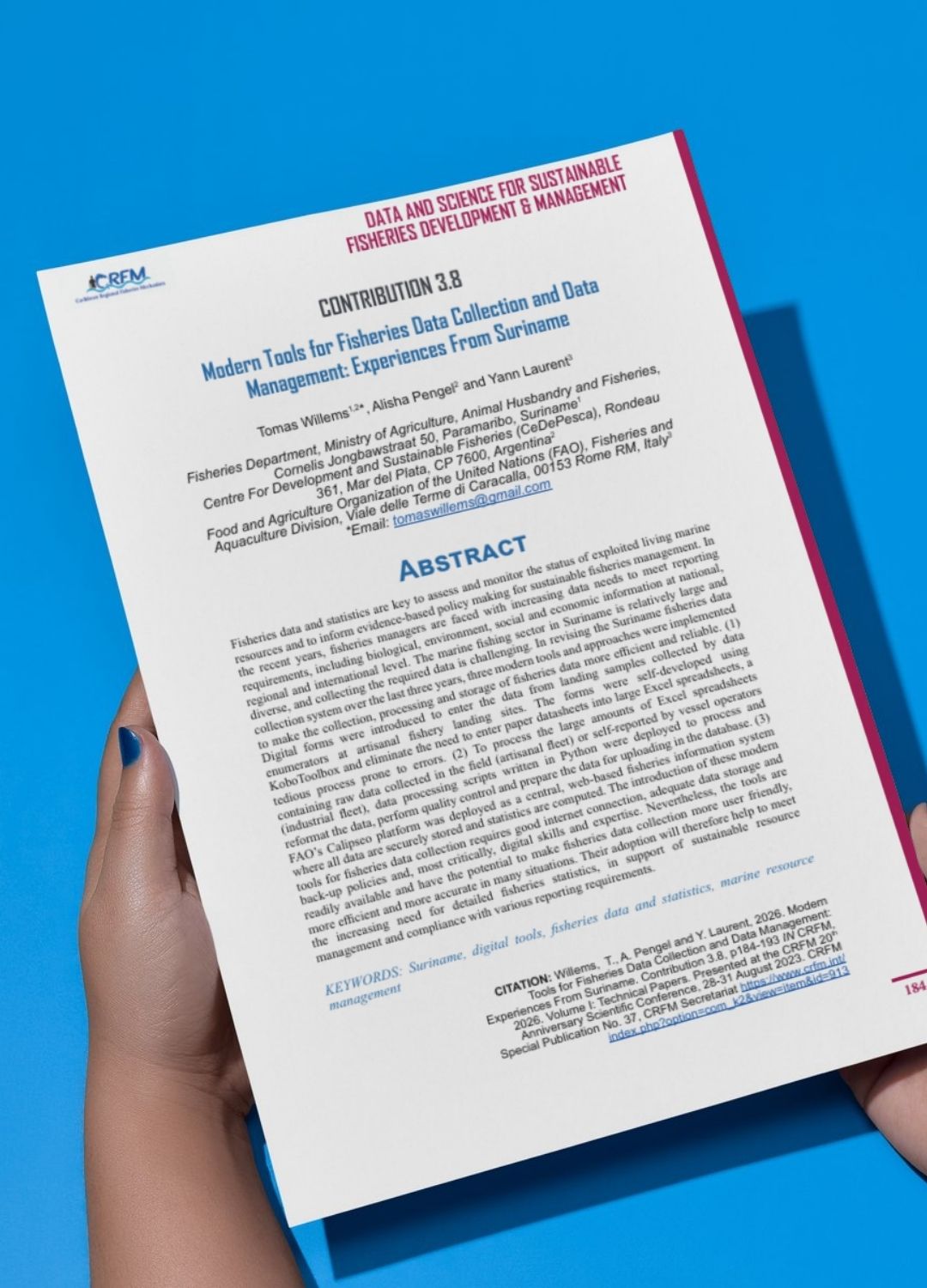 Fisheries data and statistics are key to assess and monitor the status of exploited living marine resources and to inform evidence-based policy making for sustainable fisheries management. In the recent years, fisheries managers are faced with increasing data needs to meet reporting requirements, including biological, environment, social and economic information at national, regional and international level. The marine fishing sector in Suriname is relatively large and diverse, and collecting the required data is challenging. In revising the Suriname fisheries data collection system over the last three years, three modern tools and approaches were implemented to make the collection, processing and storage of fisheries data more efficient and reliable. (1) Digital forms were introduced to enter the data from landing samples collected by data enumerators at artisanal fishery landing sites. The forms were self-developed using KoboToolbox and eliminate the need to enter paper datasheets into large Excel spreadsheets, a tedious process prone to errors. (2) To process the large amounts of Excel spreadsheets containing raw data collected in the field (artisanal fleet) or self-reported by vessel operators (industrial fleet), data processing scripts written in Python were deployed to process and reformat the data, perform quality control and prepare the data for uploading in the database. (3) FAO’s Calipseo platform was deployed as a central, web-based fisheries information system where all data are securely stored and statistics are computed. The introduction of these modern tools for fisheries data collection requires good internet connection, adequate data storage and back-up policies and, most critically, digital skills and expertise. Nevertheless, the tools are readily available and have the potential to make fisheries data collection more user friendly, more efficient and more accurate in many situations. Their adoption will therefore help to meet the increasing need for detailed fisheries statistics, in support of sustainable resource management and compliance with various reporting requirements.

HOW TO CITE: Willems, T., A. Pengel and Y. Laurent, 2026. Modern Tools for Fisheries Data Collection and Data Management: Experiences From Suriname. Contribution 3.8, p184-193 IN CRFM, 2026. Volume I: Technical Papers. Presented at the CRFM 20th Anniversary Scientific Conference, 28-31 August 2023. CRFM Special Publication No. 37, CRFM Secretariat https://www.crfm.int/index.php?option=com_k2&view=item&id=913
POWERPOINT
VIDEO PRESENTATION
FULL SCIENTIFIC PUBLICATION

Download CRFM Special Publication No. 37:
Proceedings of the CRFM 20th Anniversary Scientific Conference
KEY LINKS
Scientific Conference Home Page
Scientific Conference Proceedings Page
Explore all 20th Anniversary Scientific Papers
NOTE
If you have challenges accessing or downloading documents in this series, please email us at This email address is being protected from spambots. You need JavaScript enabled to view it. , copied to This email address is being protected from spambots. You need JavaScript enabled to view it. , or call us at +501-223-4443. Some browsers do not properly load Google Drive documents, so if you have challenges accessing the PowerPoint slides or the full special publication, try switching to another browser such as Google Chrome or Microsoft Edge.