Anguilla
  Antigua and Barbuda
  Grenada
  Bahamas
  Barbados
  Belize
  Dominica
  Guyana
  Haiti
Haiti  Jamaica
  Montserrat
  St. Kitts and Nevis
  St. Lucia
  St. Vincent and the Grenadines
  Suriname
  Trinidad and Tobago
  Turks and Caicos

Socio-Economic Features of Antigua’s Small-Scale Fisheries Sector – Implications for Economic Security and Sustainable Development
Ian Horsford
Fisheries Division, Point Wharf Fisheries Complex, St. John’s, Antigua, West Indies.
E-mail: This email address is being protected from spambots. You need JavaScript enabled to view it.
ABSTRACT
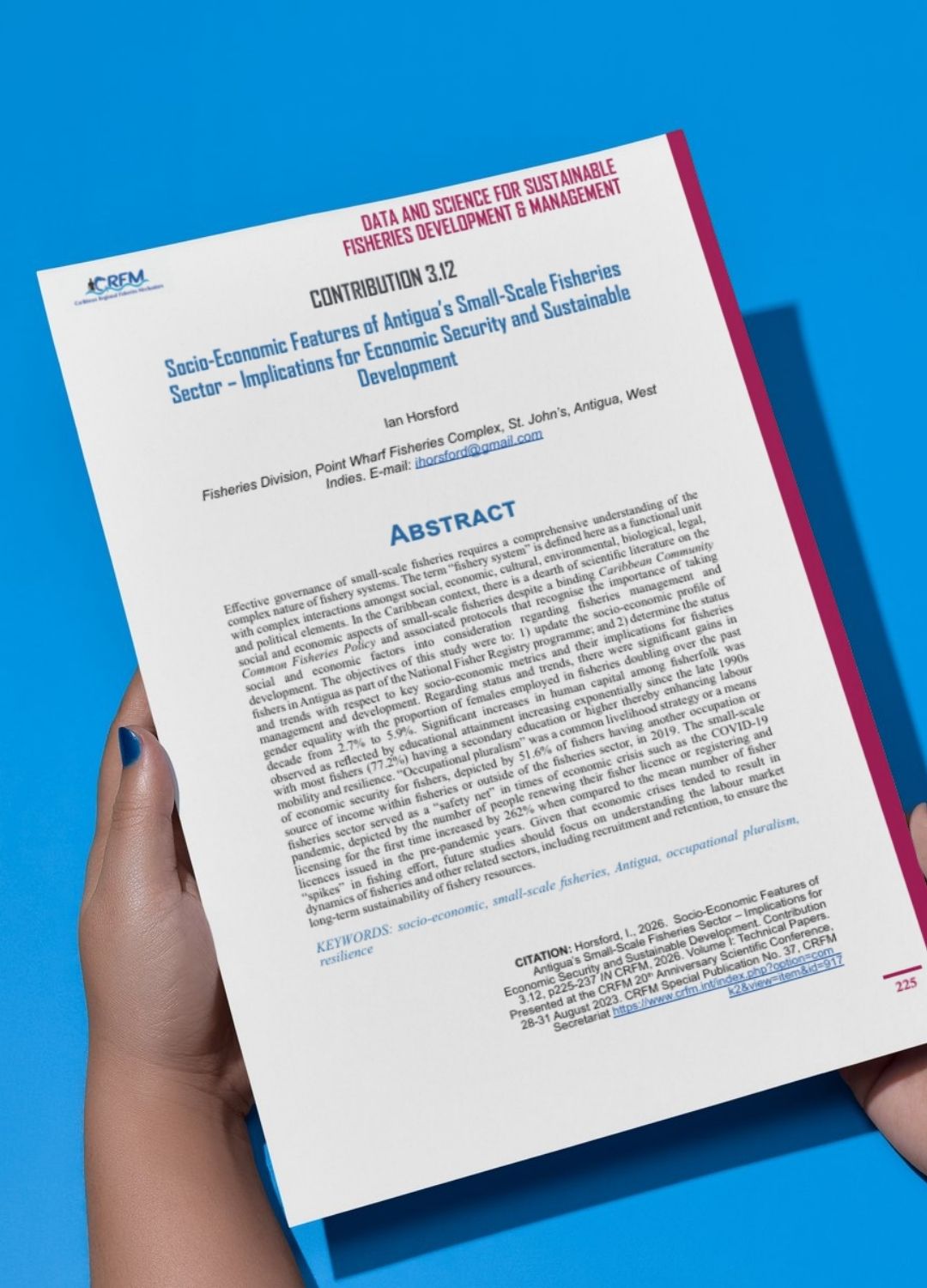 Effective governance of small-scale fisheries requires a comprehensive understanding of the complex nature of fishery systems. The term “fishery system” is defined here as a functional unit with complex interactions amongst social, economic, cultural, environmental, biological, legal, and political elements. In the Caribbean context, there is a dearth of scientific literature on the social and economic aspects of small-scale fisheries despite a binding Caribbean Community Common Fisheries Policy and associated protocols that recognise the importance of taking social and economic factors into consideration regarding fisheries management and development. The objectives of this study were to: 1) update the socio-economic profile of fishers in Antigua as part of the National Fisher Registry programme; and 2) determine the status and trends with respect to key socio-economic metrics and their implications for fisheries management and development. Regarding status and trends, there were significant gains in gender equality with the proportion of females employed in fisheries doubling over the past decade from 2.7% to 5.9%. Significant increases in human capital among fisherfolk was observed as reflected by educational attainment increasing exponentially since the late 1990s with most fishers (77.2%) having a secondary education or higher thereby enhancing labour mobility and resilience. “Occupational pluralism” was a common livelihood strategy or a means of economic security for fishers, depicted by 51.6% of fishers having another occupation or source of income within fisheries or outside of the fisheries sector, in 2019. The small-scale fisheries sector served as a “safety net” in times of economic crisis such as the COVID-19 pandemic, depicted by the number of people renewing their fisher licence or registering and licensing for the first time increased by 262% when compared to the mean number of fisher licences issued in the pre-pandemic years. Given that economic crises tended to result in “spikes” in fishing effort, future studies should focus on understanding the labour market dynamics of fisheries and other related sectors, including recruitment and retention, to ensure the long-term sustainability of fishery resources.

HOW TO CITE: Horsford, I., 2026. Socio-Economic Features of Antigua’s Small-Scale Fisheries Sector – Implications for Economic Security and Sustainable Development. Contribution 3.12, p225-237 IN CRFM, 2026. Volume I: Technical Papers. Presented at the CRFM 20th Anniversary Scientific Conference, 28-31 August 2023. CRFM Special Publication No. 37, CRFM Secretariat https://www.crfm.int/index.php?option=com_k2&view=item&id=917
POWERPOINT
VIDEO PRESENTATION
FULL SCIENTIFIC PUBLICATION

Download CRFM Special Publication No. 37:
Proceedings of the CRFM 20th Anniversary Scientific Conference
KEY LINKS
Scientific Conference Home Page
Scientific Conference Proceedings Page
Explore all 20th Anniversary Scientific Papers
NOTE
If you have challenges accessing or downloading documents in this series, please email us at This email address is being protected from spambots. You need JavaScript enabled to view it. , copied to This email address is being protected from spambots. You need JavaScript enabled to view it. , or call us at +501-223-4443. Some browsers do not properly load Google Drive documents, so if you have challenges accessing the PowerPoint slides or the full special publication, try switching to another browser such as Google Chrome or Microsoft Edge.