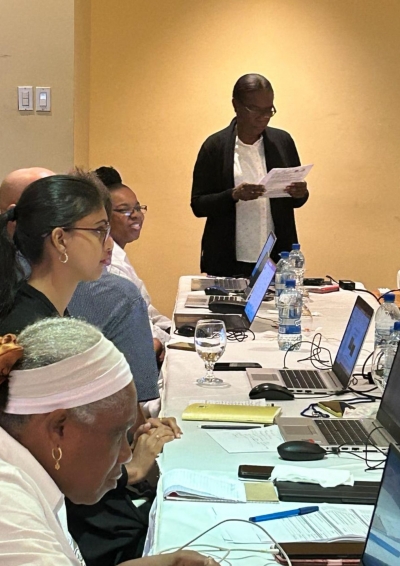
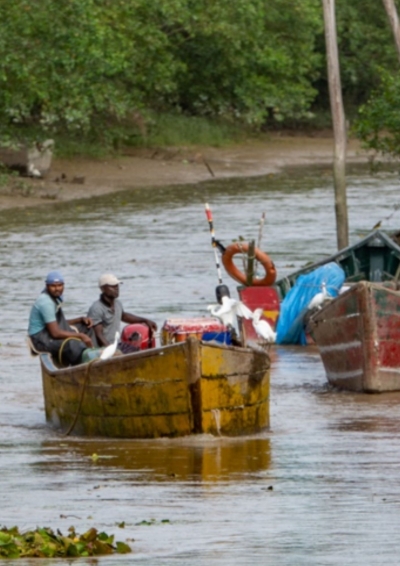
Georgetown, Guyana, 12 August 2026 (CRFM)—Fisheries professionals from countries within the North Brazil Shelf Large Marine Ecosystem (NBSLME) are better equipped to assess groundfish species using length-based data for actionable management advice that will bolster the sustainability of the region’s fisheries. This 5-day training and capacity-building workshop on Data-limited Assessment of the Groundfish Stocks in the North Brazil Shelf Large Marine Ecosystem was convened from August 3-7, 2026, at the Grand Coastal Hotel in Georgetown, Guyana.

Group Pic 1

Participants after the opening of the CRFM-CSWG Data-limited Assessment of the Groundfish Stocks in the North Brazil Shelf Large Marine Ecosystem in Guyana


The hands-on event was convened by the Caribbean Regional Fisheries Mechanism (CRFM) through the CRFM Continental Shelf Fisheries Working Group (CRFM-CSWG), which collaborated with two institutional partners—the University of the West Indies-managed EAF4SG Project and the FAO-WECAFC Shrimp and Groundfish Working Group—working along with the national fisheries authorities of three CRFM Member States: Guyana, Suriname, and Trinidad and Tobago. The session also drew participation from Brazil and Venezuela.

CRFM Deputy Executive Director, Dr. Sandra Grant, said: “The CRFM hopes—through this series of stock assessment trainings held since 2023—to improve stock assessment capacity among data managers from the NBSLME. This will be evidenced by their enhanced knowledge and application of stock assessment methods and data-limited software tools in R.”


 CSWG Group 1

Workshop attendees discussed the groundfish data and analyses

Workshop participants were exposed to training in the collection and analysis of length data, and in developing technical management advice based on the analyses derived from them. The advice would address appropriate precautionary adjustments to harvest levels that are consistent with management objectives, as well as the subsequent monitoring of management controls. Training in management advice covered appropriate practical controls, such as technical gear changes, closed areas and seasons, as well as overall effort and catch limits.


 June Masters

CRFM Statistics and Information Analyst, Mrs. June Masters, crunching numbers as she analyses length-data

"This workshop represents another important milestone in our ongoing collaboration with the Caribbean Regional Fisheries Mechanism (CRFM). In March 2025, we partnered to deliver similar training for participants from Guyana, Suriname, and Trinidad and Tobago. We are very pleased to again in 2026, cosponsor this very important and much needed workshop in partnership with the CRFM,” said Mrs. Nerissa Lucky, Technical & Project Coordinator, EAF4SG project (Enhancing capacity for the adoption and implementation of the Ecosystem Approach to Fisheries in the shrimp and groundfish fisheries of the North Brazil Shelf Large Marine Ecosystem).

Ms. Gitanjali Chandarpal, Assistant Representative, the United Nations Food and Agriculture Organization (FAO), added that, “Maintaining sustainable fisheries is crucial, and reliable stock assessments are the cornerstone of sustainable fisheries management. Even where data is limited, robust scientific methods allow us to reduce uncertainty, support evidence-based decision-making and apply precautionary approaches that safeguard both marine ecosystems and the livelihoods that depend upon them.”

Mrs. Selvine Stephenson-Grant, Deputy Programme Manager, Agricultural & Agro-Industrial Development, Caribbean Community (CARICOM) Secretariat, noted that, “Through the work of the Caribbean Regional Fisheries Mechanism, Member States continue to pursue greater cooperation in the sustainable use and management of shared fisheries resources. As the Community advances implementation of initiatives aimed at strengthening regional food systems, sustainable fisheries will continue to play an increasingly important role in ensuring healthy diets, supporting livelihoods, and building resilience across the Caribbean.”

She conveyed commendations from the CARICOM Secretariat to the CRFM Secretariat, the Government of Guyana, the FAO, the EAF4SG Project, and all participating Member States and partners for their continued leadership and commitment to sustainable fisheries management.

Ms. Desha Husbands, Fisheries Officer, who addressed participants on behalf of the Government of Guyana, said: “We cannot manage what we cannot measure, and we cannot manage what we don't know. This training workshop, facilitated by the CRFM and the EAF4SG project, addresses this need by strengthening our technical capacity through the ecosystem approach to fisheries. We can now move from a point of intuition to a point of evidence-based management.”


Willems and Medley

Dr. Tomas Willems (left) with Dr. Paul Medley at CSWG workshop


The expected outcomes of the training and capacity-building workshop on Data-limited Assessment of the Groundfish Stocks in the North Brazil Shelf Large Marine Ecosystem include:

  • Improved stock assessment capacity among data managers;
  • Stock assessment reports produced for completed assessments;
  • Improved groundfish data collection methods, featuring updated protocols to support more accurate stock assessments;
  • Enhanced understanding of the use of length-based assessment methods to support fisheries management decision-making;
  • Increased capacity to apply precautionary approaches in recommending harvest adjustments and management measures using Management Strategy Evaluations; and
  • Increased capacity to develop appropriate fisheries management controls, including gear modifications, closed seasons or areas, effort controls, and catch limits.

Dr. Tomas Willems, Head of Research & Statistics, Suriname Fisheries Department, said: “A key takeaway is that, although length-based methods do not require the long historical time series of data needed for many traditional stock assessment models, the data must still be of high quality and collected through rigorous, well-designed sampling programs. Furthermore, a sound understanding of the life history and biology of the species being assessed remains essential for obtaining reliable results.”

Dr. Paul Medley, the consultant who delivered the training, said: “It's been very productive. We made a lot of progress again. I hope that we can sustain this level of effort in trying to determine stock status. We are also developing appropriate methods for the Caribbean, so that we can monitor our stocks, our fisheries, and move towards more sustainable use.”


###

Published in Press release

Modern Tools for Fisheries Data Collection and Data Management: Experiences From Suriname


Tomas Willems1,2*, Alisha Pengel2 and Yann Laurent3

Fisheries Department, Ministry of Agriculture, Animal Husbandry and Fisheries, Cornelis Jongbawstraat 50, Paramaribo, Suriname1

Centre For Development and Sustainable Fisheries (CeDePesca), Rondeau 361, Mar del Plata, CP 7600, Argentina2

Food and Agriculture Organization of the United Nations (FAO), Fisheries and Aquaculture Division, Viale delle Terme di Caracalla, 00153 Rome RM, Italy3

*Email: This email address is being protected from spambots. You need JavaScript enabled to view it.


ABSTRACT


3 7 mockup Fisheries data and statistics are key to assess and monitor the status of exploited living marine resources and to inform evidence-based policy making for sustainable fisheries management. In the recent years, fisheries managers are faced with increasing data needs to meet reporting requirements, including biological, environment, social and economic information at national, regional and international level. The marine fishing sector in Suriname is relatively large and diverse, and collecting the required data is challenging. In revising the Suriname fisheries data collection system over the last three years, three modern tools and approaches were implemented to make the collection, processing and storage of fisheries data more efficient and reliable. (1) Digital forms were introduced to enter the data from landing samples collected by data enumerators at artisanal fishery landing sites. The forms were self-developed using KoboToolbox and eliminate the need to enter paper datasheets into large Excel spreadsheets, a tedious process prone to errors. (2) To process the large amounts of Excel spreadsheets containing raw data collected in the field (artisanal fleet) or self-reported by vessel operators (industrial fleet), data processing scripts written in Python were deployed to process and reformat the data, perform quality control and prepare the data for uploading in the database. (3) FAO’s Calipseo platform was deployed as a central, web-based fisheries information system where all data are securely stored and statistics are computed. The introduction of these modern tools for fisheries data collection requires good internet connection, adequate data storage and back-up policies and, most critically, digital skills and expertise. Nevertheless, the tools are readily available and have the potential to make fisheries data collection more user friendly, more efficient and more accurate in many situations. Their adoption will therefore help to meet the increasing need for detailed fisheries statistics, in support of sustainable resource management and compliance with various reporting requirements.

 download button CRFM Website - Sci Pub LG


HOW TO CITE:  Willems,  T., A. Pengel and Y. Laurent, 2026. Modern Tools for Fisheries Data Collection and Data Management: Experiences From Suriname. Contribution 3.8, p184-193 IN CRFM, 2026. Volume I: Technical Papers. Presented at the CRFM 20th Anniversary Scientific Conference, 28-31 August 2023. CRFM Special Publication No. 37, CRFM Secretariat https://www.crfm.int/index.php?option=com_k2&view=item&id=913 


 POWERPOINT

Download PowerPoint


VIDEO PRESENTATION 

Video-3 8


FULL SCIENTIFIC PUBLICATION

Sci Pub Volume Mockups ISci Pub Volume Mockups II 

Download CRFM Special Publication No. 37:

Proceedings of the CRFM 20th Anniversary Scientific Conference

Volume I: Technical Papers

Volume II: National Reports 


 KEY LINKS

Scientific Conference Home Page

Scientific Conference Proceedings Page

Explore all 20th Anniversary Scientific Papers


 NOTE

If you have challenges accessing or downloading documents in this series, please email us at This email address is being protected from spambots. You need JavaScript enabled to view it. , copied to This email address is being protected from spambots. You need JavaScript enabled to view it. , or call us at +501-223-4443. Some browsers do not properly load Google Drive documents, so if you have challenges accessing the PowerPoint slides or the full special publication, try switching to another browser such as Google Chrome or Microsoft Edge.

cswg banner


BELIZE CITY, Thursday, 28 March 2024 (CRFM)—The five-day Joint Stock Assessment Workshop and Stakeholder Consultation for the Atlantic seabob shrimp fisheries of Guyana and Suriname, held in Guyana from 11-15 March 2024, ended with a renewed commitment. Technical experts from the Caribbean Regional Fisheries Mechanism (CRFM) Secretariat, the Continental Shelf Fisheries Working Group (CSWG), FISH4ACP, and private sector processors agreed to keep all hands on deck to steer the fisheries towards greater sustainability.


group pic


Caribbean technical experts from the CRFM Secretariat, the Continental Shelf Fisheries Working Group (CSWG), FISH4ACP, and private sector processors collaborated for a joint stock assessment of the seabob fisheries of Guyana and Suriname

Photo: FISH4ACP, Guyana


This recent stock assessment was critical for revealing stock trends and changes in relative abundance of the seabob, enabling the technical experts to provide management advice for both fisheries in Guyana and Suriname.


“You must admit that stock assessments are becoming increasingly important to assess the sustainability of the region’s fisheries. The approach used here—governments and the private sector working together—is one that we should follow across all CRFM Member States,” said Dr. Sandra Grant, Deputy Executive Director, CRFM Secretariat.


Stephen Hall - Fleet operations (and former captain) at Heiploeg Suriname N.V., who has been a seaman for 32 years, said: “The most important thing that I learned coming out of this meeting is that there is still work to be done.” He said that he plans to continue working with the Fisheries Department in Suriname to advance the scientific assessments. He noted that the workshop and stakeholder consultation helped to strengthen their capacity for future work.


Jude Jagroop - Director at Heiploeg Suriname N.V., who has been working in the sector for 31 years, explained that the operations of the company, which has approximately 200 workers, extends along the supply chain—from fishing to processing. He noted that the seabob catches have declined, but he believes that the stock is healthy, although the species distribution may have shifted to more inshore locations.


Jagroop said that the company has two representatives on the Suriname  Seabob Working Group, and it sponsors all the costs incurred to deploy the vessels to collect data with the Fisheries Department. He added that the company also facilitates the accommodation of the Fisheries Department observers whenever needed. One of the critical improvements he cited is the need to enhance the efficiency of data capture through digitization.


Rob Banning, Project Development Manager, Parlevliet & Van der Plas, The Netherlands, highlighted the importance of certification from the Marine Stewardship Council (MSC). He said that MSC certification gives consumers extra confidence that when they buy fisheries products, they are coming from a sustainably managed resource. He added that the MSC certification labels are required for companies to sell their produce in Europe and the US, and without this certification, companies have very limited market access, and they have to sell at lower prices.


The Seabob Working Groups of Guyana and Suriname have been charged with leading the implementation of the outcomes and recommendations from the joint stock assessment workshop. Muriel Wirjodirjo, chair of the Suriname Seabob Working Group, said that they conduct a monthly review and analysis of the fisheries, consistent with the ecosystem, precautionary, and participatory approaches. The CRFM CSWG, which provides technical support to the national working groups, promotes the sustainable utilization of continental shelf resources and associated ecosystems through the review and analysis of fisheries and related data, to inform management strategies.


– END –


For further information, contact This email address is being protected from spambots. You need JavaScript enabled to view it. .

Published in Press release


Guyana fisheries sectorThe fisheries sector in Guyana provides sustainable jobs for thousands of artisanal fishers (Photo: FISH4ACP, Guyana)

GUYANA, Tuesday, 12 March 2024 (CRFM)—A technical working group of the Caribbean Regional Fisheries Mechanism (CRFM)—the Continental Shelf Fisheries Working Group (CSWG)—is collaborating with the global value chain development programme – FISH4ACP, private sector processors, and the Seabob Working Groups of Guyana and Suriname to convene a joint stock assessment workshop in Guyana from 11-15 March 2024.

The assessment of the seabob, a short-lived shallow water shrimp found in the Western Central Atlantic, will cover the stocks of Guyana and Suriname, situated in the North Brazilian Shelf Large Marine Ecosystem. The assessment aims to review and validate the most recent scientific evaluations of the Atlantic seabob fisheries of Suriname and Guyana. The results will be shared with industrial and artisanal fishery stakeholders from Guyana and Suriname for their input during the last two days of the workshop, on 14-15 March 2024.

During the workshop, regional and international technical experts will propose harvest control rules (HCRs) and the related fisheries management plans, taking into account compliance with Marine Stewardship Council (MSC) certification requirements. The seabob fisheries in both Guyana and Suriname are MSC certified; Suriname’s fishery was first certified in 2011 and Guyana’s fishery in 2019.

The Seabob Working Groups of Guyana and Suriname—which are made up of representatives from the respective Fisheries Departments, the industrial and artisanal seabob sectors, and the World Wildlife Fund (WWF)—will subsequently lead the implementation of the outcomes and recommendations from the meeting.

The CRFM CSWG aims to promote the sustainable utilization of continental shelf resources and associated ecosystems through the review and analysis of fisheries and related data, to inform management strategies, consistent with the ecosystem, precautionary and participatory approaches to fisheries management.

FISH4ACP is a five-year fish value chain development programme, spanning 2020 to 2025. It is being implemented by the Food and Agriculture Organization of the United Nations (FAO) with funding from the European Union and the German Federal Ministry for Economic Cooperation and Development.

In Guyana, FISH4ACP is working towards a sustainable, resilient, well-managed, and inclusive shrimp fishery to strengthen the country’s position as a leading exporter of Atlantic seabob shrimp while ensuring long-term stability of stocks and bringing more benefits to local fisherfolk, especially women.

The CRFM collaborates with  FAO on the implementation of FISH4ACP.

- ENDS -

Opening Ceremony - Joint CFRM CSWG & FISH4ACP Seabob Stock Assessment

 Photos shared on Flickr courtesy FISH4ACP Guyana (Dawn Maison)


LISTEN TO THE OPENING CEREMONY RECORDING


Published in Press release
Monday, 18 March 2013 22:21

Suriname

Quick Facts:

  • Information coming soon.

Related Link:

Published in Member states

Member login

Username and Password